
A handsome 1-year-and-4-month-old German Shepherd was diagnosed with a patent ductus arteriosus (PDA) in September 2026.

Unfortunately, his condition was far from straightforward. His congenital heart disease had progressed and was complicated by right-sided heart failure, fluid accumulation in his abdomen (ascites), atrial fibrillation (a dangerously fast and irregular heart rhythm), and severe pulmonary hypertension (markedly elevated pressure in the blood vessels of the lungs).
He was severely emaciated, and his little body was already fighting so many battles.
Looking at his condition, we knew the odds were not in his favour. We were deeply concerned that we might lose him to the natural progression of his disease. Euthanasia had almost become the only option his owners could see.
I could understand their fear, their exhaustion, and perhaps even their feeling of helplessness. After all, nobody wants to watch someone they love suffer.
But we asked them to give him one more chance.
One more chance to fight. One more chance to live. One more chance to experience the life that every young dog deserves.
The risk of anaesthesia? Extremely high.
This was certainly not a routine procedure. Even getting him through anaesthesia was a major challenge.
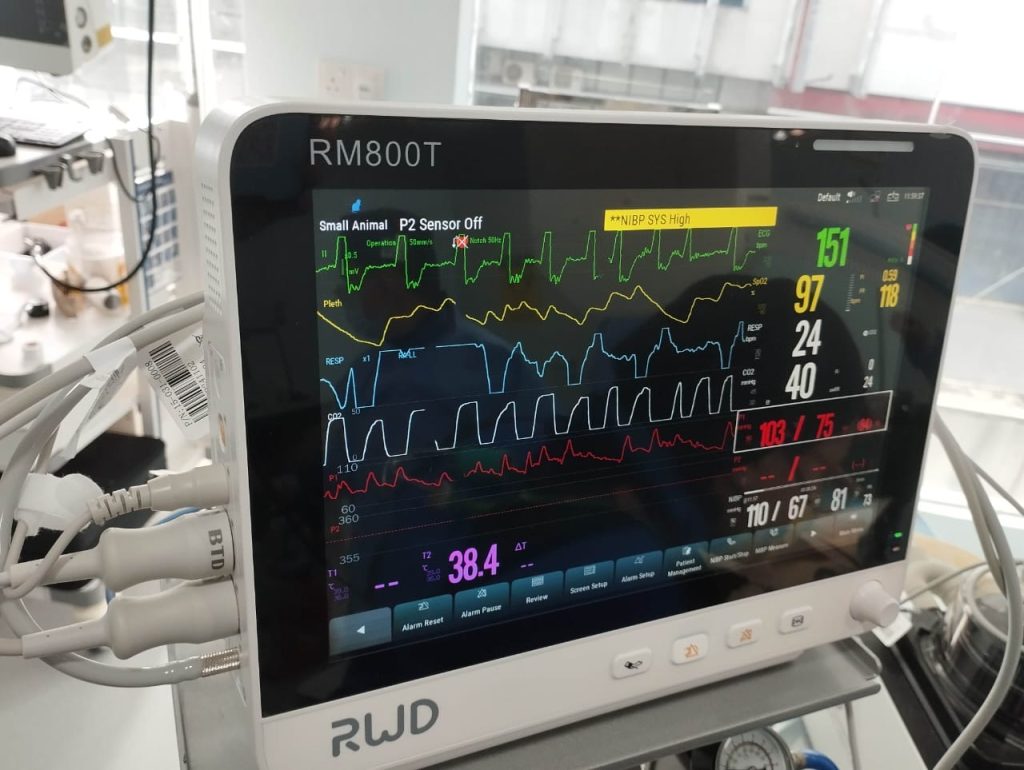
Our anaesthetic team carefully induced and maintained anaesthesia, with meticulous monitoring of his vital signs and specially tailored protocols to accommodate his severely compromised cardiovascular system.
Every heartbeat mattered. Every change in his blood pressure mattered. There was very little room for error.
On transoesophageal echocardiography (TEE), we discovered just how enormous his PDA was. It measured approximately 16 mm in length, with a minimal ductal diameter of about 4 mm.

Despite the severe pulmonary hypertension, one important finding gave us hope: blood was still flowing from left to right through the PDA.
This was crucial.
Had the PDA demonstrated right-to-left shunting (reverse shunting), we would have had to abandon the procedure, as closing it would have been contraindicated and could have put his life at even greater risk.
Thankfully, we had a window of opportunity.
And we took it.
Despite his severely compromised heart, this brave boy made it through the procedure!
Through the femoral artery, we successfully delivered and deployed the largest-sized occluder to close his PDA.

A moment of immense relief, gratitude, and emotion for everyone in the room.
To my anaesthetic team, I honestly cannot thank you enough. You were incredible. Your expertise, vigilance, dedication, and ability to keep him stable throughout such a high-risk procedure gave me the opportunity to do what needed to be done.
To everyone involved, thank you for your hard work, support, prayers, and blessings. This achievement belongs to all of us.


